#What is climate-smart soil management?
Climate-smart soil management refers to farming practices that increase productivity, improve resilience to climate change, and reduce environmental impact. The goal is to keep soils healthy so they can store nutrients, retain water, and support crops even under changing weather conditions.
#1. Use compost instead of (or alongside) chemical fertilizers
Relying heavily on synthetic fertilizers can degrade soil over time and increase costs. Compost offers a more sustainable alternative:
Improves soil structure: Compost makes soil looser and better aerated, which helps roots grow.
Enhances water retention: Soils rich in organic matter hold moisture longer, which is crucial during dry periods.
Adds nutrients gradually: Unlike chemical fertilizers that release nutrients quickly, compost feeds plants over time.
Reduces costs: Farmers can produce compost locally instead of buying expensive inputs.
Mitigates climate change: Composting recycles organic waste and increases carbon storage in soil, reducing greenhouse gas emissions.
#2. Make compost from farm materials
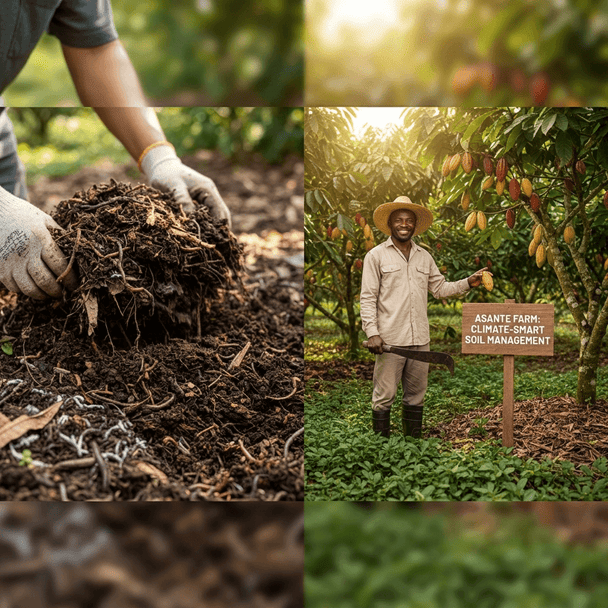
You don’t need to buy compost—you can produce it using materials already available on your farm:
Cocoa husks
Prunings from trees and crops
Leaf litter and crop residues
These materials are piled and allowed to decompose naturally. Proper composting involves:
Mixing green (fresh) and brown (dry) materials
Keeping the pile moist but not waterlogged
Turning it regularly to allow air circulation
This turns waste into a valuable soil amendment while keeping the farm clean and efficient.
#3. Irrigate during dry periods (if possible)
Climate variability often brings longer dry spells. Supplying water when rainfall is insufficient helps maintain crop growth:
Prevents plant stress during drought
Maintains yields even when rainfall is unreliable
Works especially well when combined with compost, since compost helps soil retain that irrigation water
Simple irrigation methods like watering cans, drip systems, or small-scale sprinklers can be used depending on resources.
#Putting it all together
These practices reinforce each other:
Compost improves soil health and water retention
Better soil reduces the need for frequent irrigation
Efficient water use supports crops during climate stress
Together, they create a farming system that is more productive, cost-effective, and resilient to climate change.